NVIDIA Strategic Analysis
Academic Strategy & Risk Project
Theme: Strategic Positioning, AI, Semiconductors, Geopolitical Risk & Competitive Advantage
Tools / Frameworks: PESTLE, Porter’s Five Forces, Excel, Financial Comparison, Industry Analysis
Context:
This project analysed NVIDIA’s strategic position within the semiconductor and artificial intelligence ecosystem. At the time of writing, NVIDIA had become one of the most important companies in the global technology sector, driven by demand for GPUs, accelerated computing, data centres, generative AI, gaming, robotics, and autonomous vehicles.
The project was developed as a strategic business report rather than a purely financial or technical analysis. My aim was to understand why NVIDIA had become so dominant, what made its business model powerful, and what risks could challenge its long-term position.
The report examined NVIDIA not only as a chip company, but as a platform business operating at the centre of several major technological shifts: AI infrastructure, cloud computing, high-performance computing, autonomous systems, and software ecosystems.
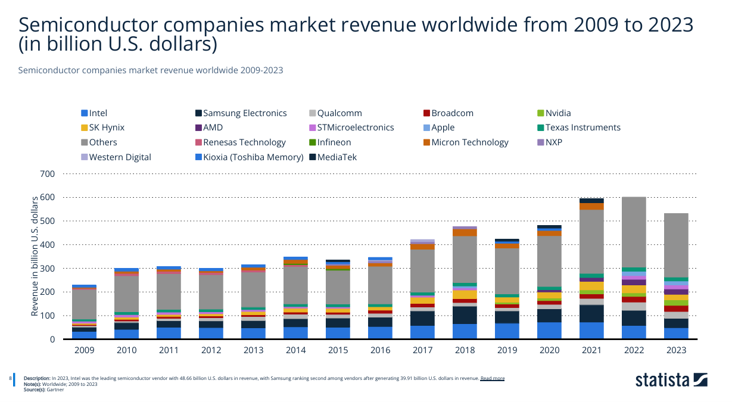
Figure 1: Statista (2024) report on semiconductors which inspired this report.
Problem:
The central problem explored in this project was whether NVIDIA’s strategic dominance is sustainable.
NVIDIA’s leadership is built on major strengths: technological innovation, GPU leadership, CUDA, data-centre demand, a fabless business model, strong free cash flow, and its position as a key supplier to the AI economy. However, the same position also creates vulnerabilities.
The company faces several strategic risks: dependence on external suppliers such as TSMC, exposure to Taiwan and Asia-Pacific supply chains, geopolitical tensions between the U.S. and China, export controls, antitrust scrutiny, open-source alternatives, environmental concerns around data-centre energy use, and intense rivalry from AMD, Intel, hyperscalers, and emerging AI hardware competitors.
The project therefore asked a broader strategic question:
Can NVIDIA maintain its leadership while managing the political, technological, environmental, legal, and competitive pressures created by its own success?
My Role:
My role was to analyse NVIDIA’s macro and micro environment, identify its strongest sources of competitive advantage, and evaluate the strategic risks that could threaten its future position.
I researched industry data, company reports, financial sources, market analysis, and business journalism. I also built selected Excel visuals, including a free cash flow comparison and geographic revenue distribution chart, to support the argument with clearer evidence.
Rather than simply describing NVIDIA’s success, I tried to evaluate the trade-offs behind its model: high profitability versus supply-chain dependence, proprietary software power versus open-source pressure, AI growth versus sustainability concerns, and global expansion versus geopolitical regulation.
Method:
The report used PESTLE to examine NVIDIA’s macro-environmental pressures and Porter’s Five Forces to evaluate its industry position.
PESTLE was used to analyse political, technological, environmental, and legal factors. This included U.S.–China export controls, reliance on Asian semiconductor manufacturing, AI market growth, sustainability pressures from data-centre emissions, intellectual property risks, data regulation, and antitrust scrutiny.
Porter’s Five Forces was used to assess the semiconductor industry structure. The analysis considered the threat of new entrants, supplier power, buyer power, substitutes, and rivalry. This helped show why NVIDIA’s market position is powerful but not risk-free.
I also used Excel to create supporting financial and strategic visuals. The free cash flow comparison helped show NVIDIA’s ability to reinvest and defend its position, while the geographic revenue chart helped highlight its exposure to global markets and geopolitical risk.
Output:
The final output was a strategic business report evaluating NVIDIA’s competitive position and long-term risks.
The report argued that NVIDIA’s advantage comes from more than hardware. Its strength lies in the combination of GPUs, CUDA, software ecosystems, data-centre demand, AI infrastructure, and platform-based lock-in. This makes NVIDIA difficult to compete with because customers are not only buying chips; they are buying into an ecosystem.
However, the report also identified several strategic challenges.
First, NVIDIA’s fabless model creates efficiency and scalability, but it also increases dependence on suppliers such as TSMC. This exposes the company to bottlenecks, geopolitical risk, manufacturing concentration, and supplier bargaining power.
Second, regulatory and political pressure creates uncertainty. Export controls on advanced chips, especially around China, can limit access to key markets. Antitrust investigations and scrutiny of NVIDIA’s acquisitions and ecosystem power also raise questions about how regulators may respond to its dominance.
Third, technological and environmental pressures are growing. Open-source alternatives and competing hardware platforms challenge NVIDIA’s closed ecosystem, while the energy intensity of AI data centres creates reputational and sustainability concerns.
The report concluded that NVIDIA’s long-term leadership depends on its ability to balance innovation with resilience: diversifying supply chains, managing geopolitical exposure, adapting to regulatory pressure, improving sustainability, and maintaining the value of its software ecosystem without alienating customers.
Skills Applied:
Strategic analysis
PESTLE analysis
Porter’s Five Forces
Geopolitical risk analysis
Market/Industry analysis
Excel
Business model analysis
Regulatory-risk assessment
Supply-chain risk analysis
Key Insight:
The biggest insight from this project was that strategic strength often creates strategic risk.
NVIDIA’s dominance makes it powerful, but it also makes it more visible, more regulated, more dependent on critical suppliers, and more exposed to geopolitical tensions. The same ecosystem that creates customer lock-in also attracts criticism from developers, competitors, and regulators. The same AI boom that drives demand also increases environmental scrutiny.
This changed how I think about competitive advantage. A strong position is not automatically a safe position. In fast-moving industries, leadership creates pressure from every direction: governments, suppliers, customers, rivals, and public expectations.
Reflection:
This project helped me understand strategy as a living system rather than a static business framework.
Before working on this report, it would have been easy to view NVIDIA mainly as a successful AI-chip company. But the deeper analysis showed that its position is shaped by a much wider network of forces: semiconductor supply chains, software ecosystems, geopolitics, export controls, data-centre energy demand, market concentration, and platform economics.
I particularly enjoyed the challenge of connecting different types of evidence. The financial comparison showed NVIDIA’s ability to generate cash and reinvest. The geographic revenue analysis showed how global exposure creates both opportunity and risk. The PESTLE analysis helped connect external pressures to strategic challenges, while Porter’s Five Forces helped explain the competitive structure of the industry.
This project also strengthened my interest in strategy and risk advisory work. NVIDIA is a good example of how modern strategy cannot be separated from technology, regulation, geopolitics, sustainability, and ecosystem control. The most interesting part of the project was not simply identifying NVIDIA’s strengths, but understanding the risks hidden inside those strengths.
If I were developing this project further, I would update the analysis with newer market data, compare NVIDIA more directly with AMD, Intel, TSMC, Google TPUs, and hyperscaler-designed chips, and build a more detailed scenario analysis around export controls, open-source AI infrastructure, and supply-chain resilience.
