AI Investment and International Business
Written By Samay Bhurat
International Business / AI Strategy Essay
Theme: Artificial Intelligence, International Business, Multinational Enterprises, Digital Globalisation, Strategic Location, Governance, OLI Framework
Tools / Frameworks: OLI Paradigm, Ownership Advantage, Location Advantage, Internalisation Theory, Institutional Theory, Digital Globalisation, AI Governance, Geopolitical Risk Analysis
Context:
This project examined how investment in artificial intelligence is transforming international business.
The essay was built around the Ownership, Location and Internalisation framework, commonly known as the OLI paradigm. This framework explains why multinational enterprises expand internationally, where they choose to operate, and why they decide to keep some activities inside the firm rather than relying on external markets, licensing, contracts, or partnerships.
AI was treated not simply as a productivity tool, but as a strategic force that changes the logic of international business itself. The essay asked how AI investment affects firm-specific advantages, location decisions, governance choices, and the uneven distribution of global competitive power.
Rather than discussing AI in a general way, the project used international business theory to structure the argument. This helped move the essay away from broad claims about automation and toward a more specific question:
How does AI reshape what firms own, where they locate, and what they internalise?
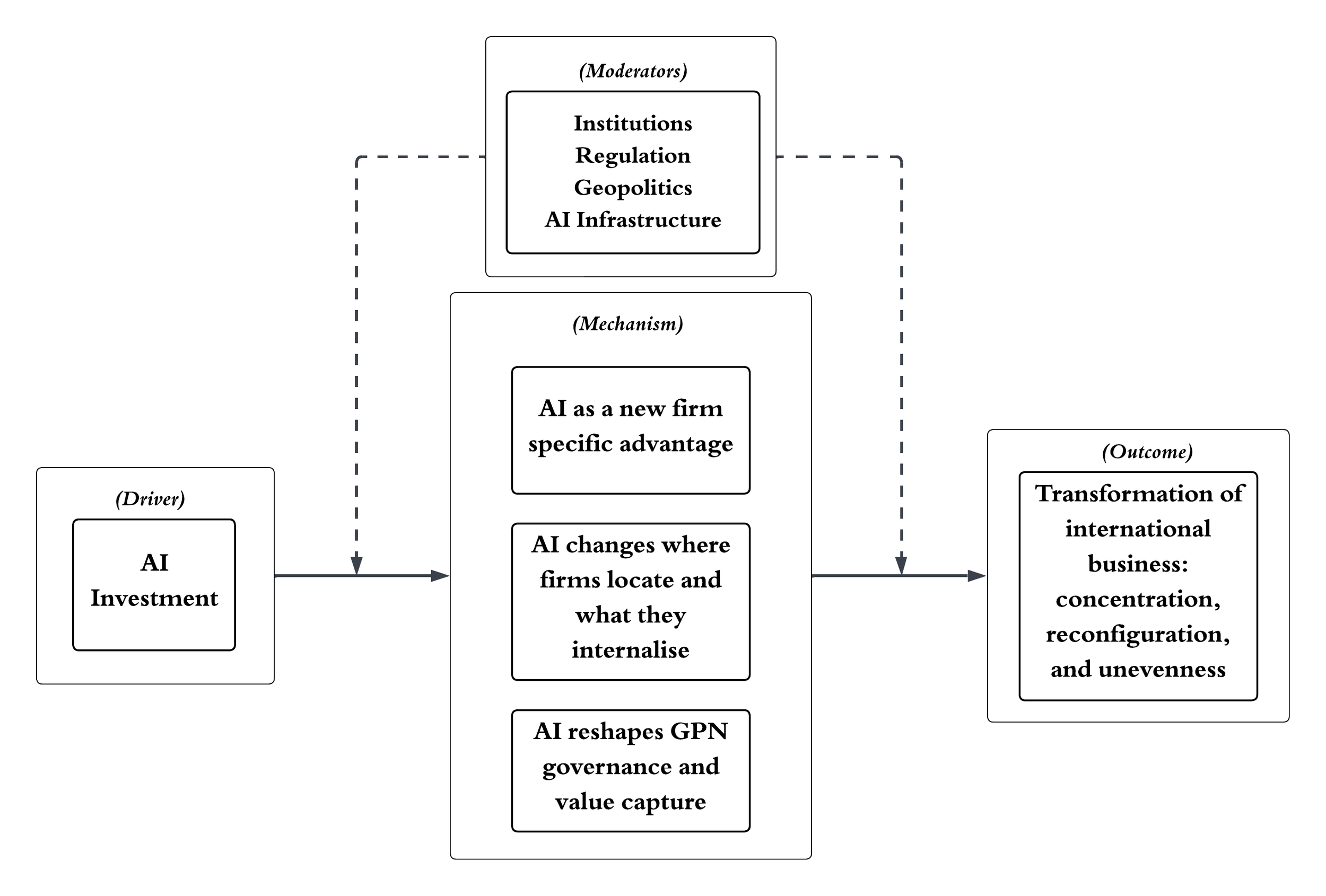
Figure 1: Conceptual model of how AI investment transforms international business through the OLI framework.
Problem:
The main problem was that AI is often discussed as if it affects all firms and countries in the same way.
Many business discussions treat AI as a general technology that improves productivity, reduces costs, and increases efficiency. While this is partly true, it does not fully explain how AI changes international business strategy. A firm’s ability to benefit from AI depends on more than whether it adopts the technology. It depends on data access, algorithms, talent, infrastructure, regulation, institutions, cloud systems, compute capacity, and geopolitical positioning.
This creates a more complex international business problem. AI may help firms coordinate across borders, enter new markets, or improve decision-making, but its benefits are not evenly available. Companies and countries with strong digital ecosystems may gain more, while weaker regions may become more dependent on external technology platforms and infrastructure.
The project therefore had to answer a critical question:
Does AI make international business more open and globally distributed, or does it reinforce concentration among firms and countries that already control data, talent, infrastructure and digital ecosystems?
My Role:
This was an individual essay project.
My role was to critically examine the relationship between AI investment and international business theory. I had to identify a suitable conceptual framework, review academic literature, build a structured argument, and connect AI investment to internationalisation mechanisms.
I chose the OLI framework because it allowed me to break the topic into three clear strategic questions:
What new advantages does AI give firms?
How does AI change the locations firms choose?
How does AI affect what firms internalise or outsource?
My role also involved designing the conceptual model that connected AI investment to ownership, location and internalisation outcomes. This helped me organise a broad and abstract topic into a clearer analytical structure.
The main challenge was avoiding a generic essay about AI. I had to keep the discussion focused on international business, multinational enterprises, cross-border coordination, governance choices, and the uneven global distribution of AI-related advantages.
Method:
The essay used a theory-led literature review approach.
I started with the OLI paradigm and used it as the main structure for the essay. The first section examined AI as a new form of ownership advantage. This included firm-specific assets such as proprietary data, algorithms, digital routines, advanced talent, AI capabilities, and the ability to coordinate knowledge across borders.
The second section examined location advantage. Here, the analysis focused on how AI changes the meaning of an attractive business location. Traditional location decisions often focus on labour costs, market size, resources, or production efficiency. In the AI era, location advantage increasingly depends on digital infrastructure, compute capacity, cloud systems, AI talent, innovation ecosystems, data regulation, and institutional stability.
The third section examined internalisation. This part explored how AI changes firm boundaries. Some activities can be coordinated externally through platforms, partnerships, digital networks, and ecosystems. However, firms may still internalise strategically sensitive activities involving proprietary data, AI models, specialised knowledge, and high-value coordination capabilities.
The final section brought these arguments together by examining institutions, regulation, geopolitics, and infrastructure. This was important because AI does not operate in a neutral global environment. Data localisation rules, fragmented regulation, chip restrictions, techno-nationalism, and unequal access to cloud and compute infrastructure all influence how far AI-based advantages can travel across borders.
Output:
The final output was a critical essay arguing that AI transforms international business by restructuring the OLI framework rather than replacing it.
The essay argued that AI creates new ownership advantages through proprietary data, algorithms, digital capabilities, coordination routines, and advanced human capital. These advantages are cumulative because firms with larger user bases and stronger ecosystems can gather more data, improve models faster, and reinforce their competitive position over time.
The essay also argued that AI reshapes location advantage. It does not make geography irrelevant. Instead, it changes what makes a location valuable. Firms increasingly seek locations with strong AI talent, digital infrastructure, reliable institutions, data ecosystems, cloud capacity, innovation clusters, and navigable regulatory environments.
The internalisation argument showed that AI encourages more selective governance choices. Firms may externalise modular or generic activities while retaining tighter control over sensitive data, AI models, high-skill capabilities, and strategic coordination systems. This produces more hybrid governance arrangements involving internal control, partnerships, platforms, and ecosystem-based coordination.
The final argument was that AI’s benefits are uneven. Countries and firms with strong infrastructure, talent, data ecosystems, and geopolitical access are better positioned to benefit. Others may become dependent on foreign cloud systems, platforms, and AI capabilities. Therefore, AI is not only a productivity tool. It is also a source of concentration, dependency, and uneven global development.
Skills Applied:
International business theory
OLI framework analysis
Theory application
Systems thinking
Key Insight:
The biggest insight from this project was that AI does not remove the importance of place.
At first, it is easy to assume that digital technologies make business more borderless. If AI systems can be accessed through cloud platforms and digital tools, it may seem like firms can operate from anywhere. However, the research showed that this is too simple.
AI depends on physical and institutional foundations: data centres, cloud infrastructure, compute power, chips, skilled labour, universities, innovation ecosystems, regulation, and political access. This means location still matters, but in a different way. Firms are not only looking for cheap production locations. They are increasingly looking for places that support data-intensive learning, AI deployment, talent access, and regulatory stability.
This changed how I think about international business. Globalisation is not becoming less geographical. Instead, the geography of advantage is being redrawn around digital infrastructure, data governance, and technological ecosystems.
Reflection:
This essay helped me develop a more strategic understanding of AI.
Before working on the project, I mostly thought about AI through the lens of productivity, automation, and efficiency. The essay pushed me to think about AI as a deeper international business force. It affects firm ownership advantages, market-entry decisions, governance structures, and global inequality.
The most difficult part was keeping the essay focused. AI is a broad topic, and it would have been easy to write a general discussion about automation or digital transformation. Using the OLI framework helped discipline the argument. It gave me a structure for analysing AI through three business questions: what firms own, where they locate, and what they internalise.
Another challenge was dealing with the unevenness of AI’s impact. The topic initially seemed to be about technology adoption, but the literature showed that adoption alone is not enough. Firms need complementary assets such as data, talent, routines, infrastructure, and institutional support. This helped me understand why the same technology can produce very different outcomes across firms and countries.
The project also strengthened my ability to connect abstract theory with current business issues. AI, data localisation, cloud infrastructure, geopolitics, and platform power are contemporary issues, but the OLI framework gave me a way to analyse them using established international business theory.
If I were to improve the project further, I would include one or two company examples to make the argument more applied. For example, a case comparison between firms using AI through cloud platforms and firms developing proprietary AI infrastructure could make the internalisation argument more concrete.
Overall, this project demonstrated my ability to use theory to analyse an emerging global business issue, structure a complex argument, and explain how technological change affects international strategy.
Professional Value:
This project demonstrates my ability to analyse emerging technologies through business theory, connect AI investment to international strategy, and explain how firms make decisions about ownership, location, governance, and global expansion.
